Wednesday, April 20, 2016

“Live Chat” = 60-Day Rollover Error


We’ve all seen that little “Live Chat” window pop up on our computers when we are browsing on certain websites. The anonymous text box repeatedly asks: “What is your name? How can I help you?” Unfortunately “help” isn’t always what you end up with when engaging in a live chat session.

As two taxpayers discovered, choosing to “Live Chat” with a random unknown customer service representative from a financial institution about your IRA transactions can be disastrous.
In Private Letter Ruling (PLR) 201452027, a taxpayer discovered that his IRA funds were deposited into an improperly titled IRA. Why is that a problem? He only had 60 days to complete the rollover and the error wasn’t discovered until the following year. The original transaction was accomplished with the help of the IRA custodian’s “Live Chat” feature on their website where customers can ask questions and make transactions on-line. The IRA titling error resulted in a failed 60-day rollover transaction – a fully taxable distribution!

Fortunately, the taxpayer had all of the necessary documentation to support the fact that it was an error due to the “Live Chat” representative’s advice and actions. The 60-day rollover waiver was granted but only after a lot of time and money was needlessly spent to obtain the PLR.

This recent PLR is a reminder of how important it is to not only speak with qualified professionals about your IRA but to also choose wisely when it comes to selecting your IRA custodian.

Tuesday, April 19, 2016

Tax Tip: Using In-Service Withdrawals for Planning Strategies

Do you have a 401(k) and want to use a portion of your funds for something else that is well suited to your planning goals and retirement needs? In-service withdrawals may be available from your 401(k) or other qualified retirement plan while you are still working and contributing to the plan.

In-service withdrawals may be directly transferred to an IRA or other qualified plan that offers you additional or alternative investment and retirement distribution options.

It is important to find out from the plan administrator what your plan’s limitations are before initiating an in-service withdrawal. There could be, for example, eligibility restrictions. This type of information should also be contained in your plan documents.

Using in-service withdrawals for planning strategies to help achieve your retirement goals can be great, but it is important to first discuss this option with your personal retirement distribution planning specialist or other professional advisor to help ensure this is appropriate for your situation.

*Keep in mind that an in-service withdrawal is not the same as a hardship withdrawal.

Monday, April 18, 2016

What is the Three Year Rule?

Certain assets are to be included in your gross estate under Section 2035 of the Internal Revenue Code, if you transferred or gifted those assets within three years of your death. This will naturally increase your gross estate value and can increase estate taxes upon death.

This rule wasn’t intended to deter people from giving gifts or transferring assets to their loved ones. It was intended to prevent taxpayers from trying to unfairly reduce or avoid federal estate tax liability once they became aware that their death is imminent by intentionally (and gratuitously) transferring ownership interest of certain assets to others.

This rule doesn’t apply to all assets but primarily applies to certain insurance policies, transfers effective at death, assets in which the owner retains a life interest and revocable transfers.

Sources: I.R.C. Sections 2035, 2036, 2037, 2038 and 2042.

Friday, April 15, 2016

Using Net Operating Loss (NOL) as a Tax Strategy for Roth Conversions

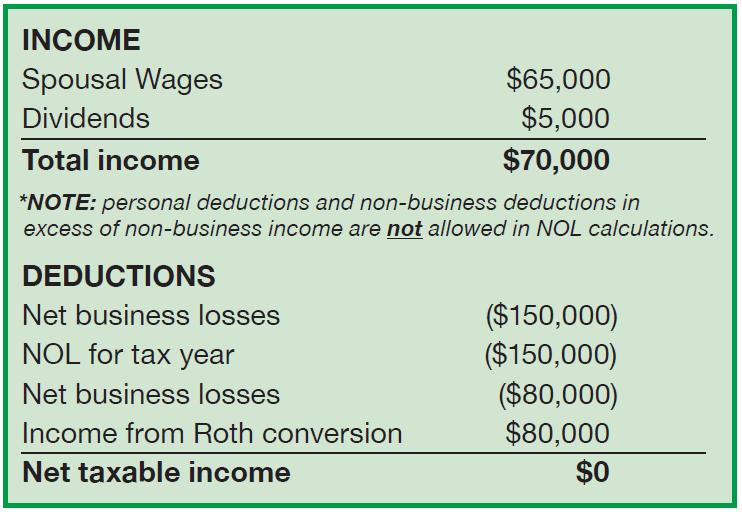
NOL calculations are complicated so this illustration is only intended to give you a general idea of how it may operate as a Roth conversion tax strategy for a business owner. You should always consult with your personal tax professional regarding your situation.

Assume a sole proprietor has $150,000 in net business losses and $80,000 in net operating losses for the year. Assume the business owner also has a SEP IRA with over $150,000. He then converts $80,000 of his SEP IRA to a Roth. Because the Roth conversion is taxed as ordinary income, he uses that Roth “income” to offset the net operating business loss:

In this example, the owner may be able to convert $80,000 of his SEP IRA without creating taxable income. If a company has a net operating loss, it may apply this tax relief in one of two ways:

1) It can apply the net operating loss to its past tax payments and receive a tax credit; or
2) It could apply the net operating loss to future income tax payments, reducing the need to make payments in future periods. The terms of the tax relief and how it can be applied varies by jurisdiction but usually the NOL can be applied to the past 2 or 3 years or to future years (carry forward).

Wednesday, April 13, 2016

Tax Time Q&A


Q: I am 61 years old; may I contribute $6,500 to each of my IRAs?

A: No. The contribution limit is an aggregate limit for all traditional and Roth IRAs you have.


Q: Are all IRA contributions tax deductible?

A: No. Roth IRA contributions are never tax deductible. The deductibility of contributions to your traditional IRA may be limited due to factors that include things like you are covered by a work place retirement plan or your income exceeds certain limits.


Q: I have over $100,000 in my old 401(k). I want to rollover my 401(k) to an IRA this year but will the $5,500 IRA contribution limit apply?

A: No. Rollovers from a work place plan to an IRA are not subject to the regular IRA contribution limitation of $5,500 ($6,500 if age 50 or older).

Q: May I deduct losses in my IRA on my 2015 tax return?

A: Not unless you withdraw the entire balance from all of your IRAs of the same type. Losses and gains are not taken into account on your tax return while your IRA is still open.


Q: Am I subject to the Net Investment Income Tax?


A: This 3.8% tax applies to certain net investment income of individuals, estates and trusts that have income above statutory threshold amounts, so whether you are subject to it depends on your individual situation. Your tax professional can help you determine the answer.

Monday, April 11, 2016

Simplifying IRA Lingo

Sometimes terminology gets confusing with respect to IRAs. Here are just a few definitions of IRA terms and concepts that are commonly asked about:

RBD: The Required Beginning Date or RBD is the date that required minimum distributions must begin for all IRA owners, which is April 1st of the year following the year an owner turns 70½. If your RBD happens to fall on a holiday or weekend, the RBD will be the following business day.

RMD: The Required Minimum Distribution or RMD is the minimum amount an IRA owner must withdraw each year from an IRA after his or her RBD. An IRA owner can always take out more than the RMD. There are no RMDs for owners of Roth IRAs but beneficiaries of inherited Roth IRAs are still subject to RMD rules.

ROLLOVER: A rollover is when assets are withdrawn from a retirement plan and then re-deposited into the same or other eligible plan. This is a reportable transaction for an IRA owner and it must be completed within 60 days. There is a 1 per year limit regardless of how many IRAs you have.


TRUSTEE-TO-TRUSTEE TRANSFER: This is a transfer of IRA funds that are sent, usually electronically, from an IRA and received directly by another IRA. Unlike a rollover, there is no limit to the number of trustee-to-trustee transfers each year.

CONVERSION: A conversion is when a traditional IRA (or SEP or SIMPLE IRA) is changed into a Roth IRA. The character of the funds is changed and income taxes will become due on the converted amount in the year of the conversion.

RECHARACTERIZATION: The term recharacterization is used when referring to a traditional IRA that has been converted to a Roth IRA but the owner wants to “undo” the conversion. Recharacterization is also used to refer to a Roth IRA contribution that an owner wishes to change into a traditional IRA contribution.

RECONVERSION: When an IRA owner converts a traditional IRA to a Roth IRA, then recharacterizes it to “undo” that conversion, but later decides that the conversion to a Roth IRA was a good idea after all; the traditional IRA is now going to be reconverted from a traditional IRA to a Roth IRA. *You cannot convert and reconvert during the same tax year or, if later, during the 30-day period following a recharacterization. If you reconvert during either of these periods, it will be a failed conversion.

Friday, April 8, 2016

Another IRA Bites the Dust

IRAs hold retirement assets that continue to grow on a tax-free basis.  Income taxes only apply when distributions are taken.  Early distribution penalties apply (10% penalty in addition to income taxes) if distributions are taken before age 59 ½ unless an exception applies.  Prohibited transactions (impermissible transactions conducted by disqualified persons) can also cause a taxable IRA event whereby the “tainted” IRA funds disqualify the IRA (it loses its tax-deferred status and is no longer considered an IRA!).  Those IRA funds are deemed a fully taxable distribution.  If under age 59½, an early 10% penalty may also apply.  Ouch. 

Unfortunately, some IRA owners still try to come up with slick ways to get around the IRS’ prohibited transaction rules…newsflash, the Tax Court is not usually going to be on your side.

In a recent Tax Court ruling, a married couple (the taxpayers) engaged in what is commonly referred to as a ROB (rollover as business start-up) with their IRA.  Their newly formed C corporation acquired assets from an existing business and they guaranteed repayment of a loan during the purchase process.  Using IRA assets to guarantee loans is a prohibited transaction.  The Tax Court reminded them that they are “disqualified persons” and that indirectly extending credit to a third party is not permitted.  Their actions resulted in a deemed distribution of all of the IRA assets.   

Are all ROBs bad?  No.  But if you plan to engage in one, make sure you know exactly what you’re getting into and exactly what you can and cannot do. 

Source: Thiessen, (2016) 146 TC No. 7