Friday, April 15, 2016

Using Net Operating Loss (NOL) as a Tax Strategy for Roth Conversions

NOL calculations are complicated so this illustration is only intended to give you a general idea of how it may operate as a Roth conversion tax strategy for a business owner. You should always consult with your personal tax professional regarding your situation.

Assume a sole proprietor has $150,000 in net business losses and $80,000 in net operating losses for the year. Assume the business owner also has a SEP IRA with over $150,000. He then converts $80,000 of his SEP IRA to a Roth. Because the Roth conversion is taxed as ordinary income, he uses that Roth “income” to offset the net operating business loss:
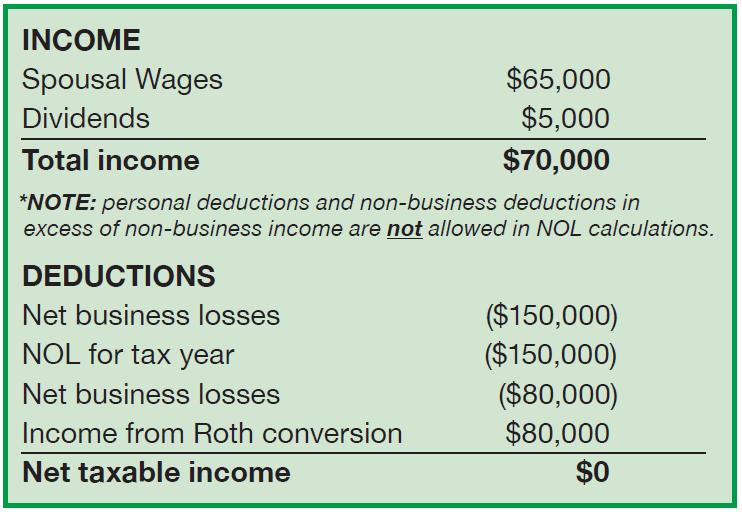
In this example, the owner may be able to convert $80,000 of his SEP IRA without creating taxable income. If a company has a net operating loss, it may apply this tax relief in one of two ways:

1) It can apply the net operating loss to its past tax payments and receive a tax credit; or
2) It could apply the net operating loss to future income tax payments, reducing the need to make payments in future periods. The terms of the tax relief and how it can be applied varies by jurisdiction but usually the NOL can be applied to the past 2 or 3 years or to future years (carry forward).

Wednesday, April 13, 2016

Tax Time Q&A


Q: I am 61 years old; may I contribute $6,500 to each of my IRAs?

A: No. The contribution limit is an aggregate limit for all traditional and Roth IRAs you have.


Q: Are all IRA contributions tax deductible?

A: No. Roth IRA contributions are never tax deductible. The deductibility of contributions to your traditional IRA may be limited due to factors that include things like you are covered by a work place retirement plan or your income exceeds certain limits.


Q: I have over $100,000 in my old 401(k). I want to rollover my 401(k) to an IRA this year but will the $5,500 IRA contribution limit apply?

A: No. Rollovers from a work place plan to an IRA are not subject to the regular IRA contribution limitation of $5,500 ($6,500 if age 50 or older).

Q: May I deduct losses in my IRA on my 2015 tax return?

A: Not unless you withdraw the entire balance from all of your IRAs of the same type. Losses and gains are not taken into account on your tax return while your IRA is still open.


Q: Am I subject to the Net Investment Income Tax?


A: This 3.8% tax applies to certain net investment income of individuals, estates and trusts that have income above statutory threshold amounts, so whether you are subject to it depends on your individual situation. Your tax professional can help you determine the answer.

Monday, April 11, 2016

Simplifying IRA Lingo

Sometimes terminology gets confusing with respect to IRAs. Here are just a few definitions of IRA terms and concepts that are commonly asked about:

RBD: The Required Beginning Date or RBD is the date that required minimum distributions must begin for all IRA owners, which is April 1st of the year following the year an owner turns 70½. If your RBD happens to fall on a holiday or weekend, the RBD will be the following business day.

RMD: The Required Minimum Distribution or RMD is the minimum amount an IRA owner must withdraw each year from an IRA after his or her RBD. An IRA owner can always take out more than the RMD. There are no RMDs for owners of Roth IRAs but beneficiaries of inherited Roth IRAs are still subject to RMD rules.

ROLLOVER: A rollover is when assets are withdrawn from a retirement plan and then re-deposited into the same or other eligible plan. This is a reportable transaction for an IRA owner and it must be completed within 60 days. There is a 1 per year limit regardless of how many IRAs you have.


TRUSTEE-TO-TRUSTEE TRANSFER: This is a transfer of IRA funds that are sent, usually electronically, from an IRA and received directly by another IRA. Unlike a rollover, there is no limit to the number of trustee-to-trustee transfers each year.

CONVERSION: A conversion is when a traditional IRA (or SEP or SIMPLE IRA) is changed into a Roth IRA. The character of the funds is changed and income taxes will become due on the converted amount in the year of the conversion.

RECHARACTERIZATION: The term recharacterization is used when referring to a traditional IRA that has been converted to a Roth IRA but the owner wants to “undo” the conversion. Recharacterization is also used to refer to a Roth IRA contribution that an owner wishes to change into a traditional IRA contribution.

RECONVERSION: When an IRA owner converts a traditional IRA to a Roth IRA, then recharacterizes it to “undo” that conversion, but later decides that the conversion to a Roth IRA was a good idea after all; the traditional IRA is now going to be reconverted from a traditional IRA to a Roth IRA. *You cannot convert and reconvert during the same tax year or, if later, during the 30-day period following a recharacterization. If you reconvert during either of these periods, it will be a failed conversion.

Friday, April 8, 2016

Another IRA Bites the Dust

IRAs hold retirement assets that continue to grow on a tax-free basis.  Income taxes only apply when distributions are taken.  Early distribution penalties apply (10% penalty in addition to income taxes) if distributions are taken before age 59 ½ unless an exception applies.  Prohibited transactions (impermissible transactions conducted by disqualified persons) can also cause a taxable IRA event whereby the “tainted” IRA funds disqualify the IRA (it loses its tax-deferred status and is no longer considered an IRA!).  Those IRA funds are deemed a fully taxable distribution.  If under age 59½, an early 10% penalty may also apply.  Ouch. 

Unfortunately, some IRA owners still try to come up with slick ways to get around the IRS’ prohibited transaction rules…newsflash, the Tax Court is not usually going to be on your side.

In a recent Tax Court ruling, a married couple (the taxpayers) engaged in what is commonly referred to as a ROB (rollover as business start-up) with their IRA.  Their newly formed C corporation acquired assets from an existing business and they guaranteed repayment of a loan during the purchase process.  Using IRA assets to guarantee loans is a prohibited transaction.  The Tax Court reminded them that they are “disqualified persons” and that indirectly extending credit to a third party is not permitted.  Their actions resulted in a deemed distribution of all of the IRA assets.   

Are all ROBs bad?  No.  But if you plan to engage in one, make sure you know exactly what you’re getting into and exactly what you can and cannot do. 

Source: Thiessen, (2016) 146 TC No. 7


Wednesday, April 6, 2016

Choose Trustee-to-Trustee Transfers

“Trustee” is a legal term that identifies an individual, an institution or a financial services entity that holds other people’s money. Employers, banks, brokerage houses and insurance companies can all be trustees. Account holders who seek to move money from one institution to another can elect to do so without taking physical possession of their money. That is, a paper check is never cut for the funds — they simply direct the transfer of their money electronically to a different retirement account. That process is called a trustee-to-trustee transfer.


Using trustee-to-trustee transfers will ensure that your time limit is met on rollovers. Missing the 60-day rollover deadline can disqualify the funds, sabotage the rollover and subject your entire retirement savings to immediate, needless and heavy taxation, destroying the opportunity of “stretching” your distribution over your life and the lives of your heirs. Your retirement distribution specialist will gladly explain to you how trustee-to-trustee transfers can help avoid tax penalties.

Monday, April 4, 2016

Who Gets Your IRA?


Do you have a will, a trust, and retirement accounts? Who will get your retirement assets? Let’s say that your will says that everything goes to your spouse, your trust says that everything goes to your children, and the beneficiary form for your IRA says that everything goes to your spouse and your children equally. Who gets your IRA?

It will go to your spouse and your children equally.

IRAs pass to beneficiaries through the beneficiary form. They don't pass by way of your will unless you name your estate as your beneficiary or sometimes, in what should never be the case, if you fail to name any beneficiaries at all. They also never get to your trust unless you name your trust as your beneficiary. You could have the best trust in the world in place to receive distributions from your IRA after your death, but if you don’t file a beneficiary form naming that trust as your beneficiary, it will never see any IRA distributions.


Whenever there are changes in your family situation, you need to think about whether your beneficiary forms need to be updated. This is especially true after a divorce or a remarriage. If you do not want retirement benefits going to an ex-spouse, then you probably have to update your beneficiary forms. If retirement benefits are meant to go to children and not to a newly married spouse, then you may need to have the new spouse sign a waiver of his or her rights to your retirement benefits. Without a waiver, the benefits might go automatically to your new spouse, cutting out your children. This is almost always true for employer plan benefits.

When there is no beneficiary form on file, you are really taking your chances. Now your retirement assets will go to whoever the company has named for you in the default language in the documents for the account. It could be a spouse; it could be your estate.

Do your loved ones a favor and make sure your retirement assets are going to the right person – the one you planned on receiving the benefits. Check those beneficiary forms.

Want to learn more?

America’s Tax Solutions™ offers an incredible 2 day program called the IRA Summit to help tax professionals fully understand the world of IRAs and 401k(s) and their role when it comes to helping clients correctly distributing these assets.

Friday, April 1, 2016

RMDs and Multiple Retirement Accounts

Most people with retirement accounts are aware that they must take RMDs, required minimum distributions each year after they turn 70½.  What happens if you have multiple retirement accounts, how are required minimum distributions (RMDs) calculated?


IRA Aggregation Rule
The basic RMD calculation is simple, using the appropriate IRS life expectancy table (which can be found in IRS Publications 590-A and 590-B) you divide the adjusted market value of your IRA balance as of December 31st of the prior year with your life expectancy factor.  This simple formula calculates your RMD amount.

If you have more than one IRA, your RMDs must be calculated separately for each IRA.  However, if you have multiple IRAs of the same type, you can aggregate your RMD amounts and take all or a portion of your RMD from one, some or all of your IRAs of the same type. 

How can this rule benefit you?  Assume you have SEP IRA Alpha that is steadily growing or contains funds that are protected from market risk.  Assume you also have SEP IRA Beta, with investments that are not doing very well.  Using the aggregate rule, you may choose to withdraw your entire RMD from SEP IRA Beta, that has not been performing very well, thereby maximizing your assets in SEP IRA Alpha while satisfying your minimum distribution requirement. 

 401(k)s and Other Employer Plans
RMDs for other plans such as 401(k)s and defined contribution plans are separate.  For each plan you must calculate your RMD and take a distribution.  The exception is if you have more than one 403(b) plan – these plans qualify for the aggregation rule.  You must separately calculate the RMD for each 403(b) but you may take your total RMD from one or a combination of your 403(b) plans. 

Inherited IRAs
The aggregation rule is only applicable to IRA beneficiaries if the same type of IRA is inherited by the same beneficiary from the same decedent.  For example, if your Aunt Sarah named you as the primary beneficiary of both her traditional IRA held at ABC Bank and her traditional IRA held at Custodian XYZ, you can use the aggregation rule with respect to these IRAs.  You cannot include your own IRA with the inherited IRAs (even if they are the same type) for purposes of the aggregation rule.


Have questions about the IRA aggregation rule?  Your America’s Tax Solutions™ retirement distribution specialist can assist you and answer your IRA aggregation questions.